How to send an alert to distribution lists and additional recipients
This defines the process for sending alerts about events on Monitor Space Hazards. It establishes who is notified, and through which channels, ensuring consistent, accurate, and timely communication to relevant stakeholders.
1. Scope
This applies to alerts concerning:
- Track Conjunction Events — predicted close approaches between two on-orbit objects, including UK-licensed operator-owned assets and third-party objects of interest.
- Track Re-entry Events — uncontrolled or controlled atmospheric re-entries of resident space objects, with particular focus on objects posing risk to UK interests.
- Track Fragmentation Events — confirmed or suspected breakup, anomalous debris release, or destructive event involving an on-orbit object nthat may impact UK-licesed assets.
This does not cover routine conjunction notifications, which are governed by separate procedures.
2. Alert types and lists
All notifications are classified into one of two tiers.
2.1 Level 1 (Standard)
A Level 1 (Standard) alert applies when the event meets the criteria described on the relevant mission set (i.e. Track Conjunction/Re-entry/Fragmentation Events)
2.2 Level 2 (Priority)
A Level 2 (Priority) alert applies when the event meets the criteria described on the relevant mission set (i.e. Track Conjunction/Re-entry/Fragmentation Events)
2.3 UK Satellites
Additionally, Track Re-entry Events has an additional distribution type for when the re-entry alert involves a UK-licensed asset called UK Satellites
2.4 Closedown
A Closedown alert is sent when the event has passed and tracking has ended
3. Alert Workflow
3.1 Trigger and intake
An alert is triggered when a relevant JSON report is uploaded to Monitos Space Hazards. New reports that change tier (Level 1 → Level 2 or vice versa) are treated as amendments to the same event.
3.2 Classification
The Orbital Analyst assigns the alert_type within the JSON report with one or more of the following labels:
standard(Level 1)priroity(Level 2)uk-licensed(Involving UK-licensed assets)closedown(Event tracking has finished)
3.3 Automatic distribution
When a report is uploaded to the service it will automatically sent to any distribution list that has been tagged with an alert_type
3.4 Manual distribution
In addition to the standard automated dispatch, alerts can be sent manually from the Monitor Space Hazards web application. This is used to extend distribution to additional lists or individually selected recipients after an alert has been issued.
Who can send manually
Manual distribution is restricted to users holding the Agency Approver or Agency Super User role.
How to send
- Open the relevant Alert page.
- Navigate to Send alert to additional recipients. This page shows the current distribution status of the alert — which lists and recipients have already been notified.
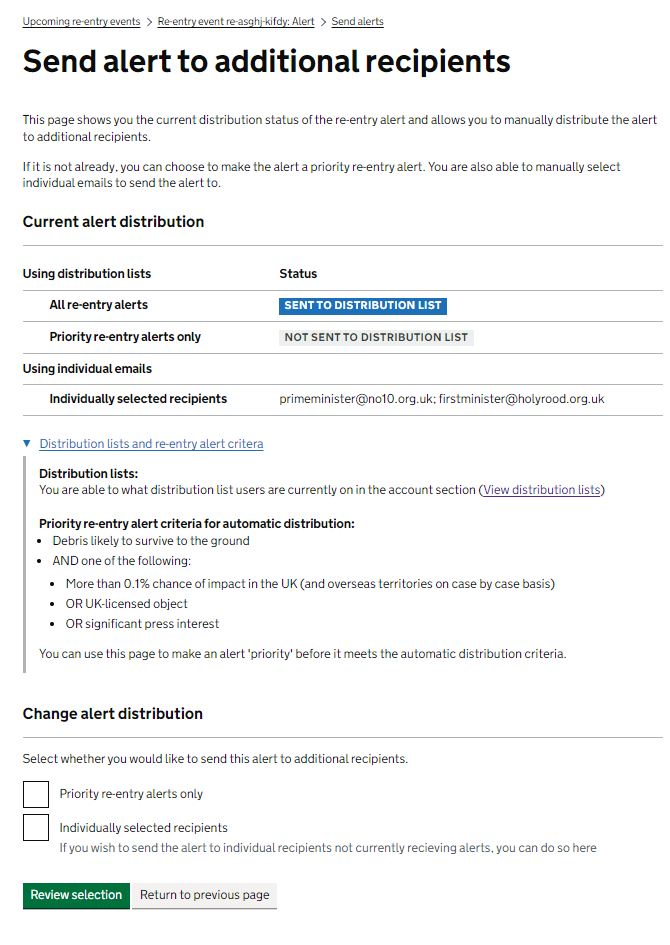
- Select the additional distribution lists, individual recipients, or both, then Review and Send.
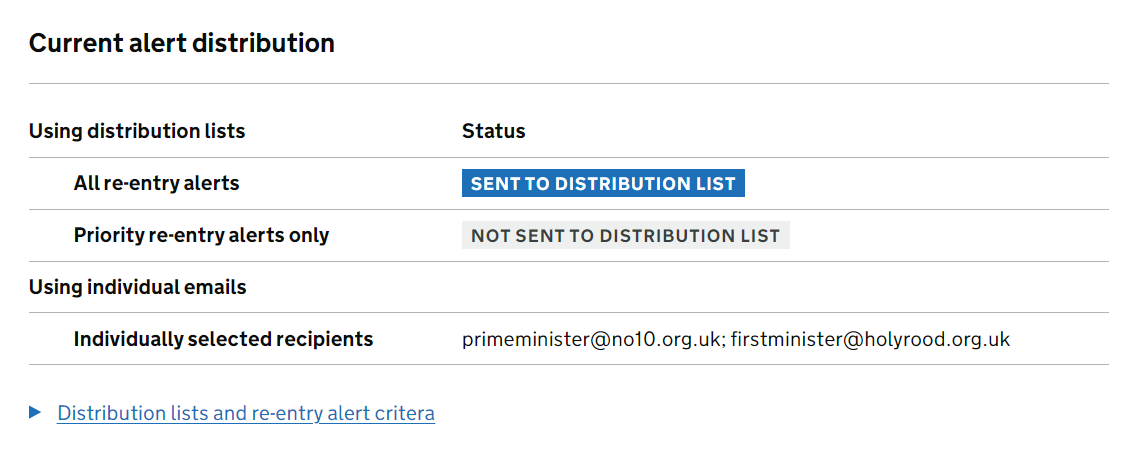
Resending to a list that has already received the alert
The system will not re-send to a list that is already marked as distributed. To resend:
- Open Send alert to additional recipients.
- Deselect every list so that no lists are selected.
- Review and Send with no lists selected. This resets the distribution state.
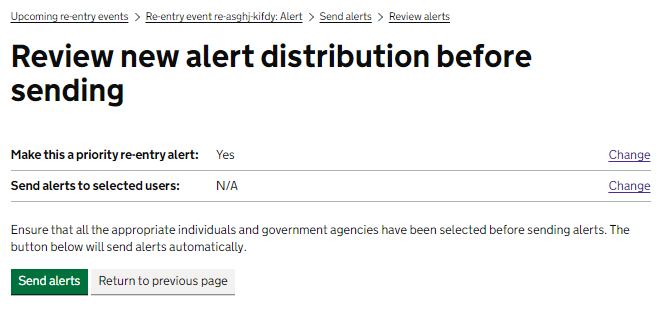
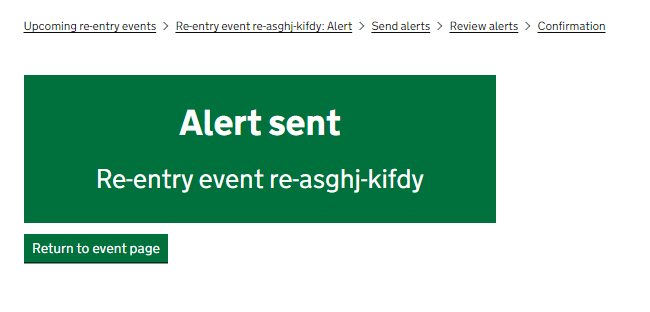
- Return to the page and select the lists you want to notify then Review and Send.
4. Channels
- Email — primary channel for all notifications
- SMS — secondary channel only used if selected by user